







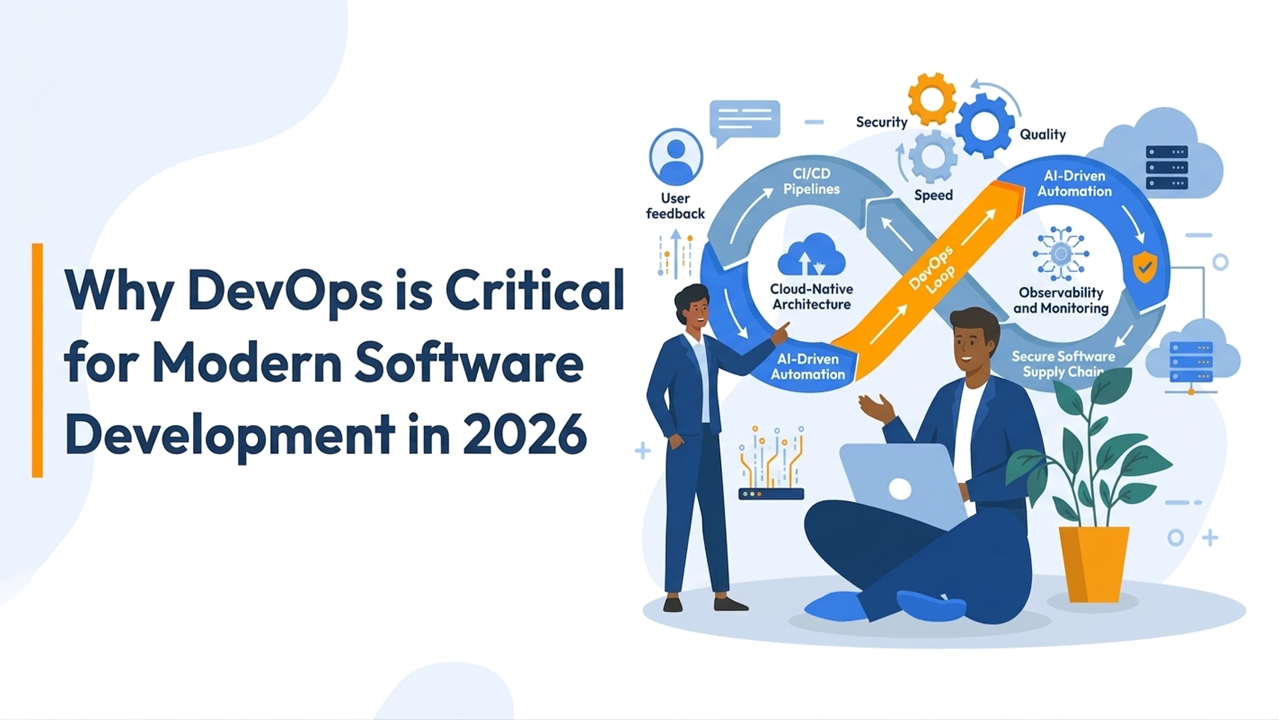
Why DevOps is Critical for Modern Software Development in 2026
Elasticity by Design: How DevOps Improves Cloud Scalability and Performance
In the early days of the cloud, “scaling” often meant manually clicking a button to add more RAM or throwing money at a larger AWS instance. In 2026, that approach is a relic. With the explosion of real-time AI agents and globalized traffic, your infrastructure needs to breathe.
DevOps is the central nervous system that makes this “breathing” possible. It transforms static servers into dynamic, high-performance environments that react to demand in milliseconds.
1. Infrastructure as Code (IaC): The Blueprint for Growth
Scalability is impossible if your infrastructure is a “snowflake”—a unique, manually configured server that no one knows how to replicate.
DevOps introduces Infrastructure as Code (IaC) using tools like Terraform or OpenTofu. By defining your cloud environment in code, you gain:
- Rapid Replication: Need to mirror your entire US-East environment in Europe to handle a traffic surge? Just run the script.
- Version Control: If a scaling event causes a performance dip, you can “roll back” your infrastructure just like you roll back a software bug.
- Consistency: Every environment (Dev, Staging, Prod) is identical, eliminating the “it worked on my machine” performance bottlenecks.
2. Microservices and Granular Scaling
In a traditional monolithic application, if your “Payment Module” is under heavy load, you have to scale the entire application. This is expensive and inefficient.
DevOps encourages Microservices and Containerization (Docker/Kubernetes). This allows for:
- Decoupled Scaling: If your “Search Bar” is getting 10x more traffic than your “Profile” page, you only scale the Search service.
- Resource Efficiency: Containers are lightweight and start in seconds, allowing your cloud to scale up and down far more aggressively than virtual machines.
3. Performance Tuning through AIOps
In 2026, humans cannot monitor every metric in real-time. AIOps (Artificial Intelligence for IT Operations) has become the secret sauce for performance.
DevOps pipelines now integrate AI to:
- Predictive Scaling: Instead of waiting for a CPU to hit 90%, AI analyzes historical patterns to scale before the spike happens.
- Automated Root Cause Analysis: If performance lags, AI identifies whether the bottleneck is a database query, a network latent issue, or a memory leak in a new deployment.
Key Performance Metric: >
$$Latency = \frac{\text{Processing Time} + \text{Queue Time}}{\text{Total Requests}}$$
DevOps aims to keep “Queue Time” near zero by ensuring resources are always available just before they are needed.
4. Scalability vs. Performance: The DevOps Balance
While often used interchangeably, scalability and performance are two different goals. DevOps optimizes for both:
| Goal | DevOps Approach | Business Outcome |
| Scalability | Horizontal Auto-scaling | The system handles 1,000 or 1,000,000 users without crashing. |
| Performance | Continuous Profiling & CDN Edge Caching | Each individual user experiences sub-second load times. |
5. Continuous Performance Testing (Shift-Left)
A common mistake is testing performance after the code is in production. DevOps “shifts left,” meaning performance testing happens during the build process.
By using Automated Load Testing in your CI/CD pipeline, you can detect if a code change decreases the number of transactions per second (TPS) the system can handle. If the performance drops, the build fails before the user ever sees it.
6. The 2026 Edge: Serverless 2.0
Modern DevOps is increasingly moving toward Serverless and Edge Computing. By offloading compute tasks to the “Edge” (closer to the user), you reduce the physical distance data has to travel. This doesn’t just improve performance; it makes scalability the cloud provider’s problem, not yours.
Final Thoughts
Cloud scalability isn’t about having a “big” server; it’s about having a “smart” system. DevOps provides the tools and the culture to ensure your infrastructure isn’t a bottleneck, but a competitive advantage. When your systems scale effortlessly, your business can too.
