






Zero-Copy Data Sharing: The End of the ETL Era in 2026
Beyond the Pipeline: Why Zero-Copy Data Sharing is the 2026 Gold Standard
For decades, the standard response to “I need that data” was “I’ll build a pipeline.” We extracted, transformed, and loaded (ETL) petabytes of information, creating a spiderweb of brittle connections and endless duplicates.
In 2026, that model has hit a wall. With the rise of Agentic AI – which requires absolute real-time truth to make decisions—waiting for a nightly batch sync is no longer an option. Enter Zero-Copy Data Sharing: a paradigm shift where data stays exactly where it lives, but acts everywhere it’s needed.
1. What is Zero-Copy Data Sharing?
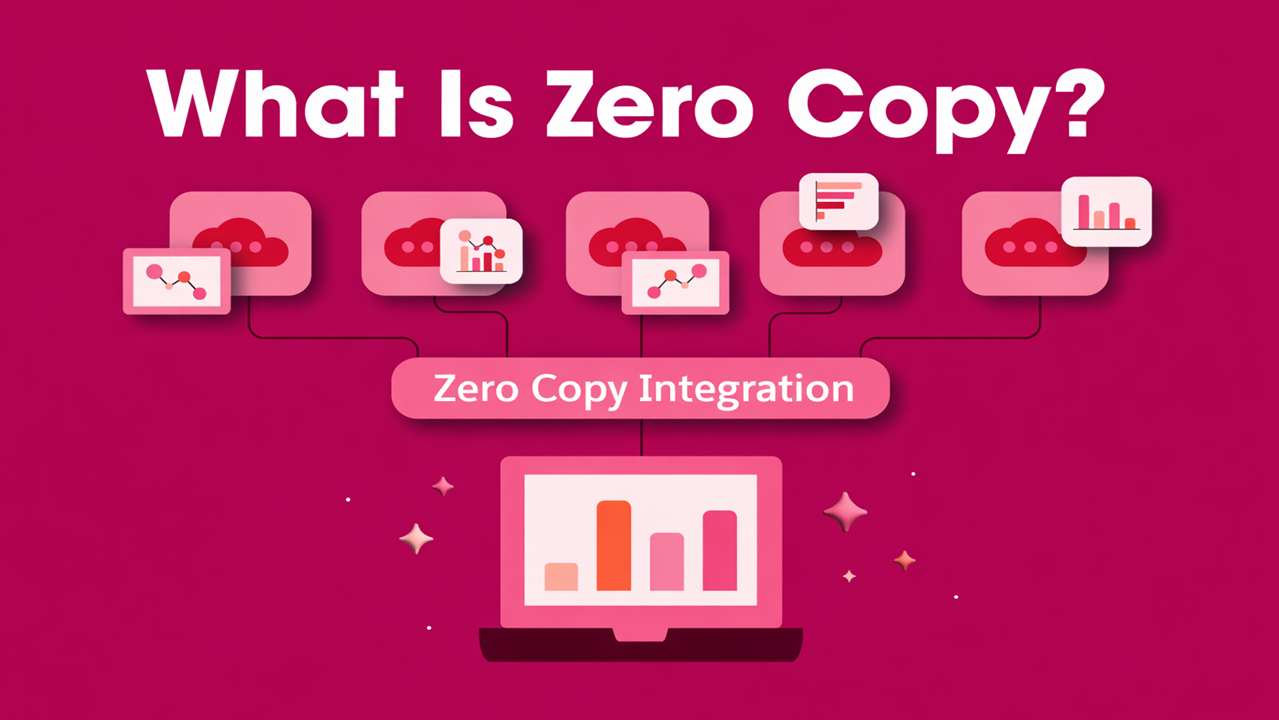
At its core, Zero-Copy Data Sharing (also known as Data Federation or Live Sharing) allows a “consumer” to query data directly from a “provider’s” storage without physically moving the bytes.
Instead of sending a file, the provider shares metadata and access permissions. The consumer “mounts” this data as if it were a local table. When the consumer runs a query, the compute engine reaches out to the source files in real-time.
2. The Economic Reality: 2,000 Credits vs. 70 Credits
In 2026, “FinOps” isn’t a buzzword; it’s a survival strategy. Traditional data movement is expensive in three ways:
- Egress Fees: Cloud providers charge you to move data out of their regions.
- Storage Bloat: You pay for the same data in your Lakehouse, your CRM, and your Marketing tool.
- Compute Overhead: ETL jobs consume massive amounts of processing power just to shuffle bits.
Recent benchmarks show that Zero-Copy federation can cost as little as 70 credits per million records, compared to 2,000+ credits for traditional batch pipelines. That is a 96% reduction in operational cost for data access.
3. Comparing the Old vs. the New
If you are architecting a stack today, the choice between “Copy” and “Zero-Copy” defines your agility.
| Feature | Traditional ETL / ELT | Zero-Copy Data Sharing |
| Data Movement | Physical duplication | Virtual “mounting” (No movement) |
| Latency | Minutes to Days (Batch lag) | Instant / Real-time |
| Source of Truth | Becomes fragmented | Remains at the source |
| Governance | Complex (Policy must follow data) | Centralized (Policy stays at source) |
| Maintenance | High (Pipelines break on schema change) | Low (Direct access to live schema) |
4. The 2026 “Big Players” in Zero-Copy
The dream of a “Zero-ETL” world is being powered by cross-platform alliances that were unthinkable a few years ago:
- Snowflake & Databricks: Through open standards like Apache Iceberg and Delta Sharing, these rivals now allow users to share data across clouds and platforms without a single API call.
- Salesforce Data Cloud: Their “Bring Your Own Lake” (BYOL) strategy allows Salesforce to “read” data directly from Snowflake or BigQuery as if it were a native Salesforce object.
- Microsoft Fabric: Using “OneLake Shortcuts,” Microsoft allows you to mount AWS S3 or Google Cloud Storage buckets into your Power BI reports without copying the data.
5. Why AI Depends on Zero-Copy
In 2026, we are building situational awareness for AI. If an AI customer service agent is looking at a “copy” of a database that is 4 hours old, it might promise a refund that was already processed or suggest a product that just went out of stock.
Zero-copy ensures that the “context” provided to a Large Language Model (LLM) is the absolute current state of the business.
The 2026 Mantra: If the data moves, the context dies. Keep the data in place to keep the AI smart.
6. Common Challenges & Best Practices
It’s not all magic; there are trade-offs to consider:
- Performance Jitter: Querying data across regions can introduce latency. Pro Tip: Use “Zero-Copy Acceleration” (caching) for frequently accessed datasets to balance speed and cost.
- Vendor Lock-in: Ensure your sharing protocol uses open formats like Parquet or Iceberg so you aren’t tied to one provider’s proprietary sharing tool.
- Security Granularity: Because you are giving an external tool access to your “home” storage, use Attribute-Based Access Control (ABAC) to mask sensitive PII (Personally Identifiable Information) before sharing.
Final Thoughts
Zero-Copy Data Sharing is the final nail in the coffin for the “siloed” enterprise. By moving the query to the data rather than the data to the query – we are building a faster, cheaper, and more secure digital ecosystem.
